HAS ANYBODY SEEN THE PHOTOGRAPH OF AN INFILTRATOR
מישהו ראה פעם תצלום של מסתנן?
7.3.19
Michal Bar-Or
Michal Bar-Or
Michal Bar-Or | Nir Harel | May Omer | Ronit Citri
Curator: Debby Farber
ABOUT
אודות
“Has Anyone Ever Seen a Photograph of an Infiltrator?”
The exhibition “Has Anyone Ever Seen a Photograph of an Infiltrator?” seeks to examine the absence of visual images of so-called “infiltrators” from official photography archives during the period of military rule in Israel. In today’s spectacle-driven society, where vision is the primary mode of mediation, everything is measured by its visibility. In such an era, the absence of images from the field of vision directly impacts how a phenomenon is perceived—whether it gains meaning or is erased from consciousness, whether it becomes seen or remains shrouded in darkness.
Beginning in the 1950s, a new term emerged in Israeli discourse: “infiltration.” Tens of thousands of Palestinian refugees, former residents of Palestinian cities and villages, crossed into the newly established state in an attempt to reclaim their belongings, visit family members who had remained behind, observe their emptied homes that had been repopulated by others, and, in many cases, attempt to return. Within the dominant public discourse, this phenomenon was framed as the most severe political problem of the time, branding these refugees with the label “infiltrators.” Despite its centrality, the discourse on infiltration is almost entirely devoid of visual representation, rendering these figures virtually invisible. This condition—where infiltrators exist “outside the gaze”—and the attempt to extract them from this state of invisibility is the core subject of this exhibition.
The exhibition seeks to transform their absence from a vague abstraction into a contemporary perspective—one that is not merely causally linked to a singular historical narrative but rather presents a present in which the reality of the past persists. This present encapsulates the historical event as a material sign, one that cannot be dismissed or erased, an absence that carries a presence.
Selected Works from the Exhibition
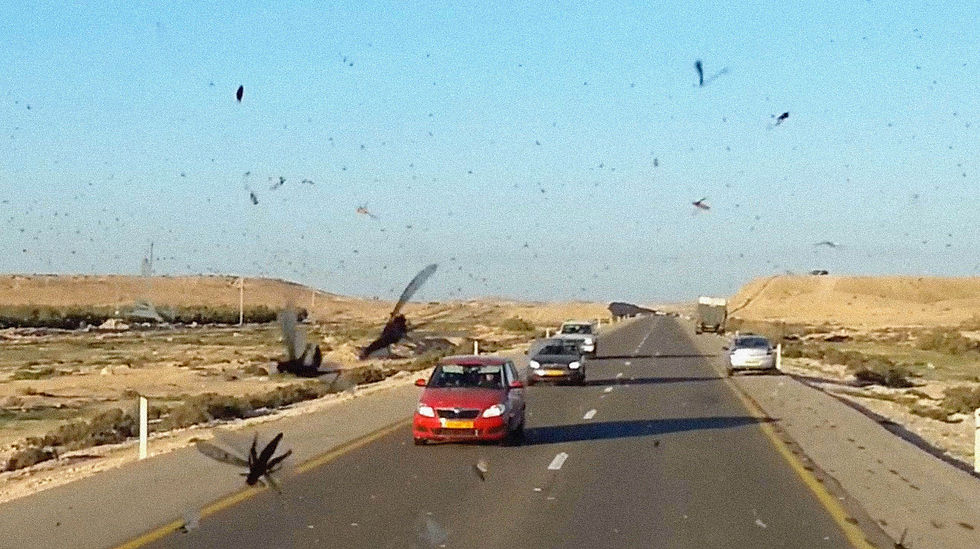
In her work “Arbeh B’Gvulecha” (“Locust in Your Borders”), Michal Bar-Or traces another form of infiltration that took place during these years: the locust swarms. Her film uncovers a path of fear, disgust, horror, and even fascination aroused by this foreign invader—one that does not conform to geopolitical boundaries or territorial divisions, one that knows no borders between lands or nations. This complex relationship with the locust encapsulates a broader historical narrative, one that intertwines Israel’s existential anxiety over destruction and annihilation with a simultaneous hunger for power and exploitation.
In “A Bit of Observation,” Ronit Citri juxtaposes a contemporary photograph of an infiltrator from Jordan with six historical landscape photographs of kibbutzim, documented by the photographer Zoltan Kluger. Through this juxtaposition, she weaves multiple narratives, constructing a broader landscape image that reveals layers hidden from the conventional gaze.
Nir Harel’s work, “A Proposal for a Set Design,” is a 3D simulation depicting a dystopian, perhaps even apocalyptic environment composed of makeshift stage sets. Each set tells a story through shapes and symbols that are both concrete and ambiguous, both familiar and unknown. The work suggests a reflection on how narratives are mediated for future generations.
May Omer’s work, “Root/Rock/Journey – The Figure of the Traveller,” is a trilogy of ten drawings that offers a visual and textual interpretation of the interplay between colonial logic and imagination, invention, and even erasure. Each of the three parts of the work engages with questions of identity, symbolism, policy, territory, the dismantling of territories, unity, and multiplicity.
This exhibition challenges the boundaries of vision and memory, questioning the mechanisms of visibility and the ways in which historical narratives are constructed, mediated, and at times, erased.


