.jpeg)
HORROR VACUI
HORROR VACUI
9.7.15
Installation Photography: Barak Brinker
Installation Photography: Barak Brinker
Yonatan Ulman | Lihi Chen | Amir Tomashov
Curator: Hagar Bril
Installation Photography: Barak Brinker
ABOUT
אודות
The works in this exhibition disrupt the typical slow and contemplative pace of gallery viewing. They obstruct, block, and obscure. Rather than striving for ideal conditions of visibility, Horror Vacui turns its focus to an encounter with a fragmented, obstructed, and deliberately inaccessible space.
To live is to move from one space to another, doing our best not to collide.
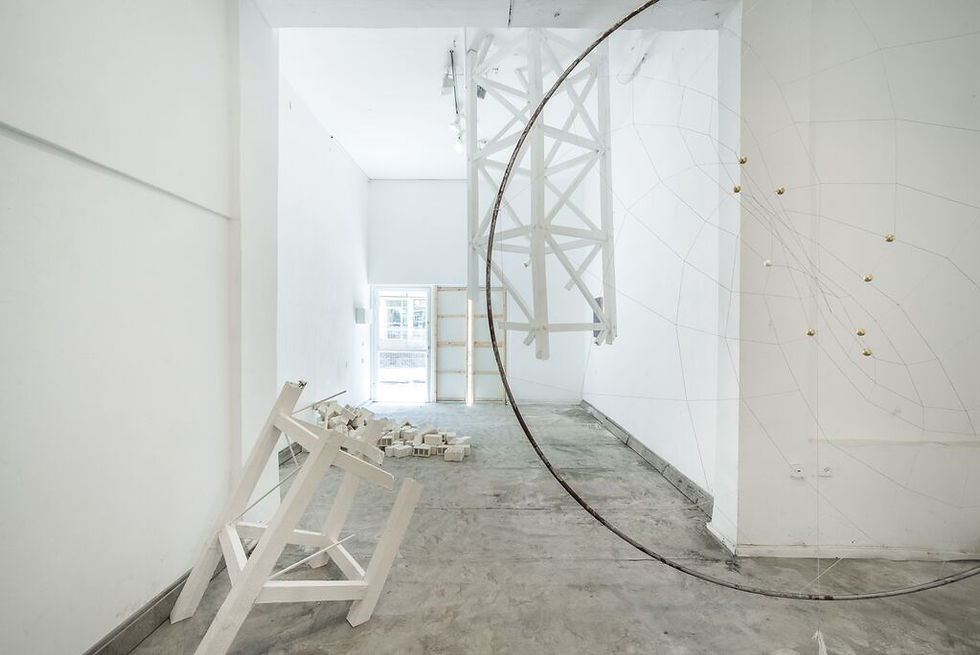
Here, we are met with resistance: the entrance is blocked by a pile of bricks, the floor is coated in cement powder, and the window reflects back a distorted image instead of offering a view inside. Two large sculptural elements hang from the ceiling, impeding movement, closing off corners, and making certain areas physically unreachable. The space feels empty—and yet, paradoxically, dense.
Is the exhibition even ready?
The Latin term Horror Vacui, meaning “fear of empty space” or “fear of emptiness,” has deep philosophical roots. The pre-Socratic philosophers, in their efforts to understand the nature of existence, argued that a true vacuum could not exist—that emptiness was an illusion. In art history, the term is commonly associated with geometric-period Greek pottery, densely decorated with repeated patterns and schematic depictions of animals, plants, and human figures. But it has also been used to describe later artworks teeming with intricate details, where every inch of the surface is filled.
The artistic desire to represent the spaces our bodies inhabit is ancient and multifaceted: from the composite perspectives in Egyptian tomb paintings, to the linear perspective of Renaissance art, to early 20th-century Cubism, and on to the fully immersive, digitally constructed realities of cyberspace. Art has never abandoned its engagement with space—and that relationship continues to shape both artistic creation and modes of exhibition.
In his book Understanding Installation Art: From Duchamp to Holzer, art theorist Mark Rosenthal explores the role of space in artistic practice. He argues that while some theorists mark the 20th century as a decisive philosophical shift in how space is understood in art, the relationship between artwork and environment has always been central. Rosenthal supports this claim by analyzing the animal paintings in the Lascaux Caves in France—one of the earliest known examples of human art—as site-specific works. These images, created directly on the cave walls and embedded with ritualistic meaning, were never meant to be moved or separated from their context. From this, Rosenthal concludes that space has always played a fundamental role in the creative process.
Thousands of years after Lascaux, we find ourselves in an age where technology enables the construction of flexible, fluid environments. We watch films in three dimensions, maintain avatar-based relationships in digital role-playing games, speak face-to-face with loved ones across oceans—and reach them by plane in a matter of hours. Paradoxically, the space around us is both expanding and contracting.
This shift in spatial perception profoundly affects the visual arts. Beyond the ways in which space is depicted within artworks, the very experience of space has become central to how exhibitions are curated and how artworks are encountered. The practical questions are endless:
Should paintings face away from sunlight?
How should lighting be calibrated to avoid glare?
Must gallery walls remain white?
Should visitors follow a prescribed path through the exhibition, or roam freely?
How close may they get to the work without endangering it?
What can be touched? What must be protected?
Should seating be provided for a 12-minute video, or will visitors stand?
Speakers or headphones?
Can this work even be shown here?
Is the gallery space empty—or have we overfilled it?
How much control should we exert over the viewer’s experience?
What is the proper amount of breathing room?
These questions may seem contemporary, but viewing conditions have always been shaped by display contexts: from the closed cabinets of curiosity, to the glass palaces of 19th-century world’s fairs, to archival vaults, biennales, museums, and the ubiquitous white cube. Each of these environments sought to create a specific, often guided, experience for their visitors.
The exhibition Horror Vacui aims to interrupt that script.
Jonathan Ullman’s floor installation coats the entire gallery with cement powder that temporarily captures the footprints of visitors. The work is ever-changing—reshaped by the very presence of the audience.
Amir Tomashov’s crane descends from the ceiling, offering a nonstandard, almost threatening vantage point on the machinery used to construct the environments we inhabit. Beneath it, a pile of construction bricks blocks the gentle, habitual circulation typical of gallery movement.
Lihi Chen’s suspended sculpture—part dreamcatcher, part star map, part portal—spins on its axis and defies the viewer’s ability to move around it. It can be seen, but not fully grasped.
There is almost nothing here—and what is present resists comfortable viewing.
The space is emptied, and yet it overflows.
Are we still afraid of the void?


